
Cliff City to Teahouse: 7 Days from Chongqing to Chengdu
7-Day | Chongqing, Wulong, Dazu, Chengdu Tour
Two Sichuan Basin cities that could not be more different. Chongqing stacks itself up a cliff between two rivers and runs on noise and chilli; Chengdu spreads out flat and green and runs on tea. Between them sit the collapsed caverns of Wulong and the last great monument of Chinese Buddhist cave art at Dazu. A single one-hour train connects the two halves.
Per person based on 2 travelers in 4-star hotels
Highlights
- A city built on a cliff: Ride the Yangtze cableway across the river, then watch the Liziba monorail pass straight through a residential block.
- Old Chongqing, still working: The 1750s Huguang Guild Hall, the 500 arhats of Luohan Temple, and the stone steps of Xiahaoli and Shancheng Alley.
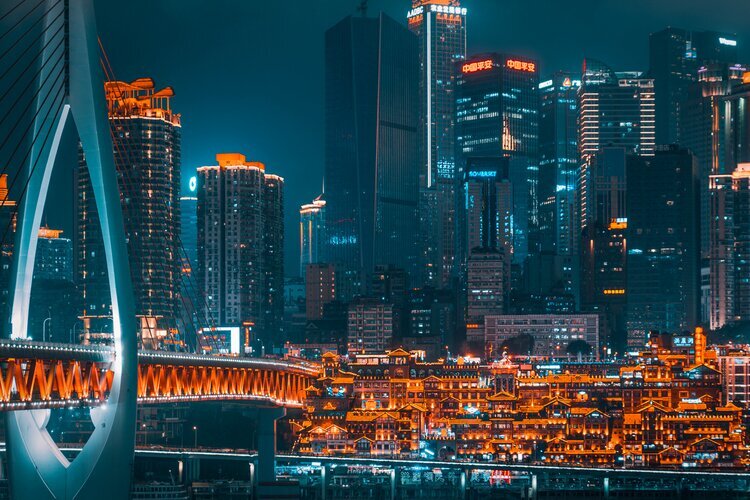
- Hongya Cave after dark: Eleven storeys of stilted timber lit in gold above the Jialing — the image most people bring home from Chongqing.
- Wulong's Natural Three Bridges: Walk the floor of a collapsed cave system beneath three arches 200 m high, with shuttles and electric carts included.
- The Dazu rock carvings: A UNESCO site carved between the 9th and 13th centuries, with a 31 m reclining Buddha and a Guanyin of 1,007 hands.
- A full panda morning: Chengdu's breeding base in the early hours, when the cubs are awake — with the internal electric cart included.
- Two very different table cultures: Chongqing's hotpot-heat lunch menus and Chengdu's slow teahouse mornings, both arranged by your guide.
- No wasted transfers: One high-speed rail leg between the cities, first class, with guides waiting at both platforms.

Tour Itinerary
- voco Chongqing Chaotianmen
- None
You land at Chongqing Jiangbei International, and your guide is waiting at the arrivals exit with a China Travel sign. The drive to Chaotianmen takes about 40 minutes, crossing the Jialing River into the narrow peninsula where the old city sits between two rivers.
Your hotel faces the confluence — the Yangtze on one side, the Jialing on the other — and the room is a good place to watch the barges work the current after dark. Nothing else is scheduled; the evening is yours.
- voco Chongqing Chaotianmen
- Breakfast, Lunch
Chongqing is built on cliffs, and the fastest way to understand that is to hang above them. The Yangtze River Cableway has been running since 1987 — a single span across the river, about a kilometre, four minutes in the air, with the whole stacked skyline of the south bank sliding past the window. Your ticket is one-way, so you ride across and come back by road with the river below you.
Back on the north bank you visit the Huguang Guild Hall, built by migrant merchants from Hubei, Hunan, Guangdong and Guangxi in the 1750s. It is the best surviving piece of old Chongqing: a series of courtyards and opera stages stepping down toward the water, with the guild's business records and emigrant history told in the side halls.
Lunch is a standard set menu at a local restaurant — this is where the city's famous chilli heat shows up on the table for the first time, and your guide will order to a tolerable level if you ask.
The afternoon keeps to the theme of the vertical city. First the Liziba monorail, which runs straight through a residential block on the sixth to eighth floors — you ride a stop yourself and then watch it happen from the viewing platform below, which is the only way to believe it.
Then Xiahaoli Old Street, a slope of stone steps and timber houses on the south bank that has been rehabilitated without being sanitised — tea houses, barbers, a few artisans, and a view back across the water to the skyscrapers.
After dark, Hongya Cave — eleven storeys of stilted timber building climbing the cliff above the Jialing, lit in warm gold after dusk. It is a shopping and dining complex dressed as a fortress, and it is genuinely spectacular from the road bridge opposite, which is where the photographs are taken.
- voco Chongqing Chaotianmen
- Breakfast, Lunch
The day starts quietly at Luohan Temple, a working Buddhist monastery tucked into the commercial district. Its Hall of the Arhats holds 500 terracotta figures, each with a different face and posture — some laughing, some scowling, one with a long eyebrow he has wound around his body. Fortune-telling by counting arhats from a random starting point is still practised here.
A few minutes' walk away is Jiefangbei pedestrian street, the commercial heart of the city and its most concentrated crowd. The monument at the centre was raised in 1947 and has been renamed twice since; the shops around it now run to eight floors underground.
After lunch the afternoon is given to a long walk across the hill: the Shancheng Alley steps up from the old town, then Eling Second Factory — a 1950s printing works converted into studios, bookshops and coffee bars, with the patched concrete and painted slogans left in place — and finally Eling Park and its viewing bridge above the river bend, the highest easily reached point in the city centre.
Dinner is not included tonight; your guide will suggest somewhere within walking distance of the hotel.
- voco Chongqing Chaotianmen
- Breakfast, Lunch
A full day out of the city, south-east into the Wulong karst, about three hours each way by road. The Natural Three Bridges are not bridges at all but the collapsed roofs of an enormous limestone cave system, leaving three arches spanning a gorge 200 to 300 m deep.
You walk down into the gorge floor and follow it beneath all three arches — Tianlong (Sky Dragon), Qinglong (Azure Dragon) and Heilong (Black Dragon) — past the thermal spring at the far end and the Transformers 4 filming location that put the site on the map for international visitors.
Your ticket includes the scenic-area shuttle and the internal electric carts, which matters here: the gorge floor is 4 km end to end and the climb back out is 800 steps without them.
The day is timed within an eight-hour vehicle window, so you are back in Chongqing for a late dinner of your own choosing.
- voco Chengdu Chunxi Road
- Breakfast, Lunch
You leave Chongqing west for Dazu, about 1.5 hours by road, to see the rock carvings at Baodingshan — the finest of the five Dazu sites and a UNESCO World Heritage listing since 1999.
The carvings were cut between the 9th and 13th centuries, at the same time as Europe was building its cathedrals, and they are the last great monument of Chinese Buddhist cave art. What makes them unusual is the subject matter: alongside the Buddhas and bodhisattvas there are scenes of ordinary life — a woman feeding chickens, a buffalo herder playing a flute, parents wheeling a barrow — carved as parables of virtue rather than as decoration.
The Reclining Buddha is 31 m long and lies on its side in a shallow niche, and the Thousand-Hand Guanyin beside it carries 1,007 hands, each with an eye in the palm — restored over eight years and completed in 2015. Your ticket includes the site's environmental shuttle.
Lunch is a standard set menu near the site, then you are driven to Dazu South Station for the 17:55 high-speed train to Chengdu, arriving at 18:59 — just over an hour for the 300 km. Your Chengdu guide meets the train and takes you to your hotel on Chunxi Road.
- voco Chengdu Chunxi Road
- Breakfast, Lunch
Wenshu Monastery opens the day — Chengdu's best-preserved Buddhist temple and still an active one, with incense burning from dawn and a vegetarian restaurant that local families queue for. The halls run back through five courtyards; the garden teahouse at the rear is where you will want to sit.
Then the Chengdu Research Base of Giant Panda Breeding on the northern edge of the city. Your ticket includes the internal electric cart, which is not a luxury — the base covers 100 hectares and the panda houses are spread across it.
Go early and go to the far enclosures first: the cubs are most active in the morning, and by late morning most adults have gone back to sleep in the shade. You will see animals of every age from newborns in the nursery to adults working through a morning's bamboo.
Lunch is a standard set menu with a Chengdu speciality — Long Chaoshou wontons, or a table of small dishes if the group prefers.
The afternoon closes at Jinli Old Street, a restored Qing-era lane beside the Wuhou Shrine, with a tasting card for the snack stalls: dan dan noodles, rabbit skewers, three-cannon rice cakes, sugar-figure blowing. Note that sections of the street are periodically closed for maintenance, and the route adjusts if your date falls in one.
- Breakfast
Your guide meets you at the hotel at the time agreed the evening before and drives you to Tianfu or Shuangliu International for your flight home, ending a seven-day route that has run from the cliff city of Chongqing through the Wulong karst and the Dazu carvings to the teahouses of Chengdu.
What's Included
- Hotels are included in the itinerary.
- China's domestic flights/trains are specified in the itinerary.
- Entrance fees, cable cars, scenic shuttles and boat rides as listed.
- Meals are detailed in the itinerary.
- Private transfers.
- Private English-speaking guide and driver.
- Hands-on workshops and cultural experiences as listed.
- Service charges and taxes.
Notes
- The itinerary outlined above can be customized to align with your personal interests and preferences. Please feel free to share your thoughts with us, and we will gladly make the necessary adjustments.
- Pricing is subject to change based on the itinerary, activities, travel season, number of participants, and hotel selection. We provide accommodations across all levels for our tours, including renowned 5-star hotel chains, well-located 4-star hotels, and high-value 3-star hotels at various destinations.
- The Wulong day is operated within an eight-hour vehicle window; the drive each way is approximately three hours.
- Sections of Jinli Old Street are periodically closed for maintenance, and the route is adjusted where a closure affects your travel dates.
- Chongqing's lunch menus are prepared to local heat levels. Tell your guide at the start of the tour if you would prefer them adjusted.